
Feminism and Autonomy Conundrums
Two explorations into women's equality from different sides of the political spectrum

(This post is about a four-minute read. To listen to instead, scroll to the bottom of the page.)
The rainy season in Vancouver is beginning. The days are shorter and darker; everywhere leaves are bursting into shocks of flaming colour, then dying. Time to curl up inside and read.
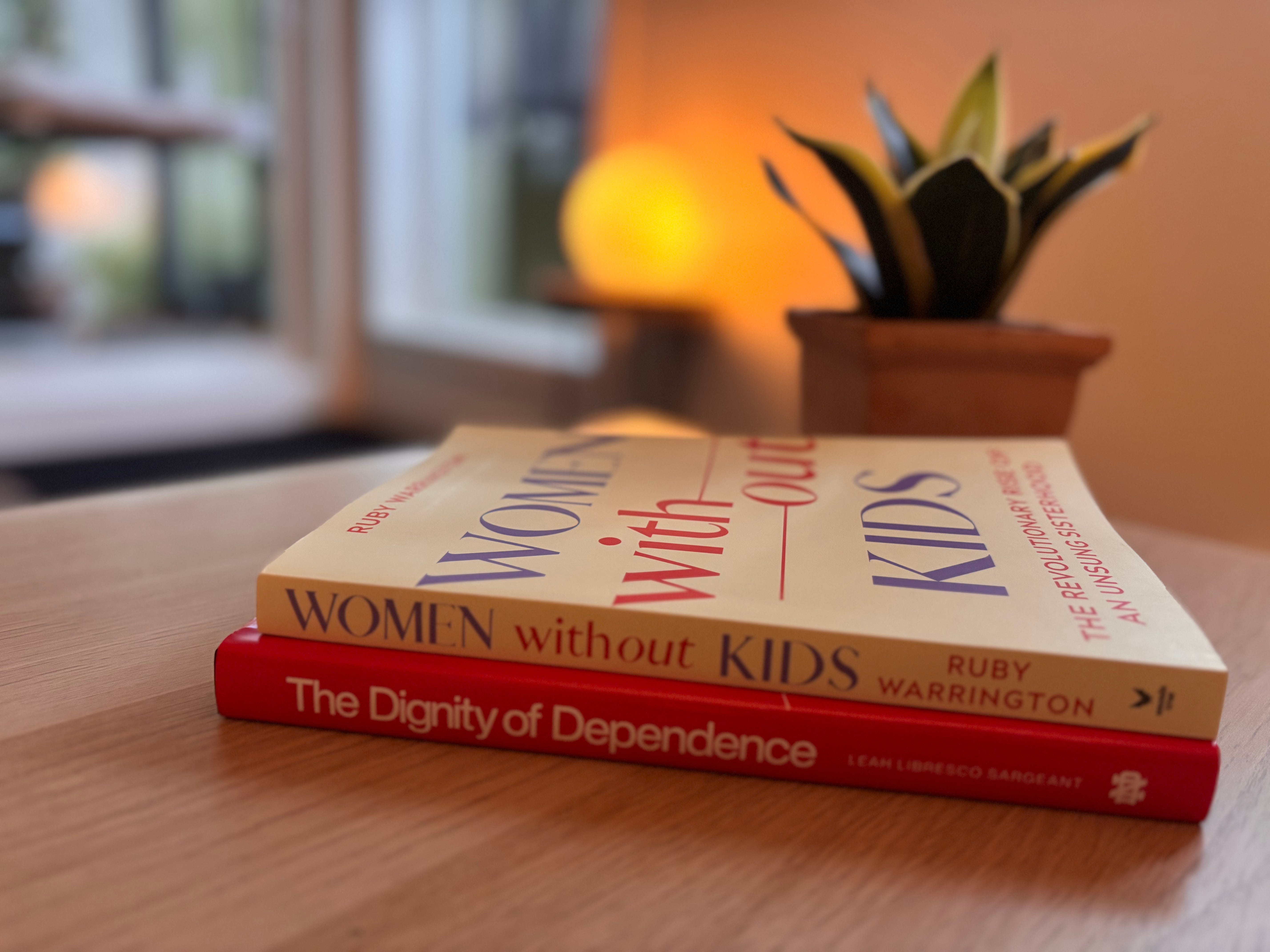
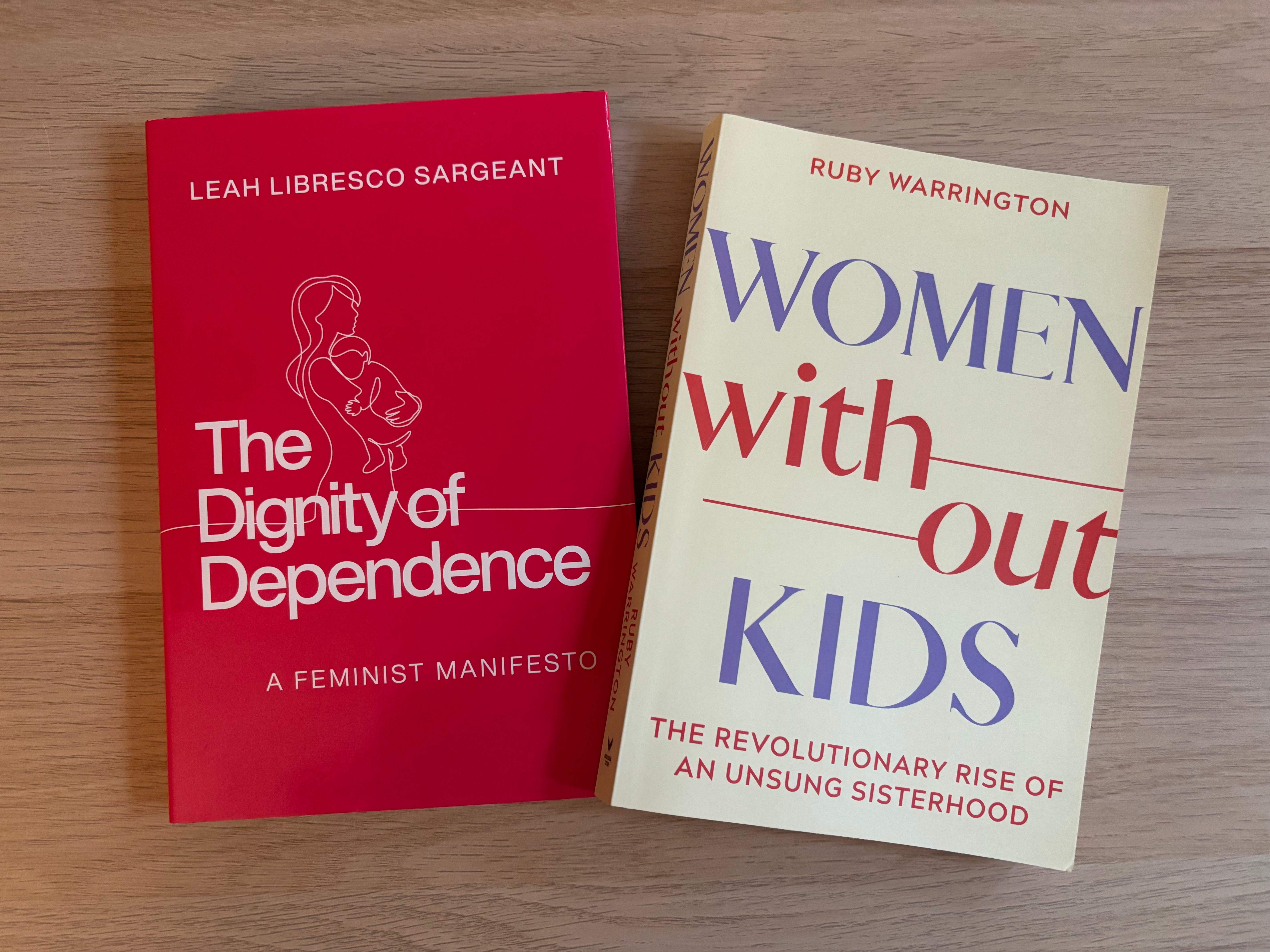
I want to discuss two of the books I’ve read this fall on Counterparts: Women Without Kids by Ruby Warrington and The Dignity of Dependence by Leah Libresco Sargeant. In part because they each have valuable insights in their own right, and because they express different facets of feminism that I rarely see in conversation with each other.
I’ll dig into some ideas in each book in my next two essays, but first, here’s a brief introduction.
WWK articulates a secular perspective on women who don’t want or never have kids, what it means to break away from ingrained stories of women as primarily mothers, and what new legacies women are creating. DoD makes a Catholic feminist case for social structures that account for dependence and care for others, arguing that women get hit first and hardest in workplaces and other settings that don’t support caregivers.
Ruby sees pro-natalist perspectives as harming women because they often come with the belief that motherhood is an essential part of womanhood, regardless of circumstances, inclinations, temperaments or skills. She defines pro-natalism as an ideology that says, “parents are more important than nonparents, and that families are more respectable and valid than single people.” Not having kids has meant fewer interruptions in Ruby’s career as a journalist and writer, an experience more typical for men. She sees this as an asset. “Not being a mother makes me more like a man. A definite advantage in a world built by men, for men.”
In contrast, Leah assumes that pregnancy and motherhood figure largely in most women’s lives. And she tackles the realities of a “world built for men” head on, identifying the ways this impacts women (everything from average counter heights being too high to job insecurity after parental leave). She argues that asking women to adapt to these male patterns is harmful to women and proposes we redesign the patterns.
Pregnancy and early childcare are the most visceral gendered differences. I think we can all agree we need a feminism that can welcome mothers—as individuals, yes, but also as individuals whose lives can sustain another human life in ways their male counterparts cannot. This shouldn’t be a controversial idea, but it’s become contentious, I think in part because much of feminist thought in the second and third “waves” focused on freeing women of anything that makes them different from (read: unequal to) men. Intentionally or not, this positioned male autonomy as the goal.
“Feminism and motherhood have a complicated relationship,” Amy Westervelt wrote several years ago in “Is motherhood the unfinished work of feminism?”:
Radical feminist Shulamith Firestone articulated this most starkly in her argument that women would never truly be free of patriarchy until they were freed from the yoke of reproduction. She imagined wistfully a day when babies could be created in mechanical uteruses, freeing women from the physical subjugation of childbirth.
In contrast, Adrienne Rich argued that it was the patriarchal notion of motherhood, not the actual experience of mothering, that was the source of women’s oppression. Meanwhile womanists saw in this interpretation of motherhood yet another way in which white feminists were ignoring their experiences, oblivious to the history of eugenics and forced sterilization that played into how women of color viewed reproduction. While white feminists often painted motherhood as the ultimate apparatus of patriarchy, many activist women of color saw in motherhood not only freedom but also agency.
Leah’s work is one of many voices today speaking up for the majority of women who have or will have children. The complicating factor here (and one many conservatives struggle with) is that motherhood isn’t something every woman wants. Some women cannot or do not have children—in increasing numbers and for many reasons; we need to make space for their voices and experiences too.
I believe both WWK and DoD have got something right.
In my next two essays, I’ll share insights to mull over from each of these books. Putting these two authors in conversation is messy. And that’s intentional. Figuring out gender equality in relational, communal, and societal settings is messy and complex, especially when considering motherhood.
In many Christian circles, it remains taboo for married couples to choose not to have children. Voluntary childlessness is often type-cast as having the wrong priorities: being too selfish, too fearful, too immature. In many progressive circles, anything that sounds too “pro-family” is often considered oppressive and suspect. It frustrates me to see people on both ends of the spectrum talking over and past one another instead of sitting at the same table, sharing concerns. In a small way, that’s what my next two posts aim to do.
Yes, this audio is AI generated.